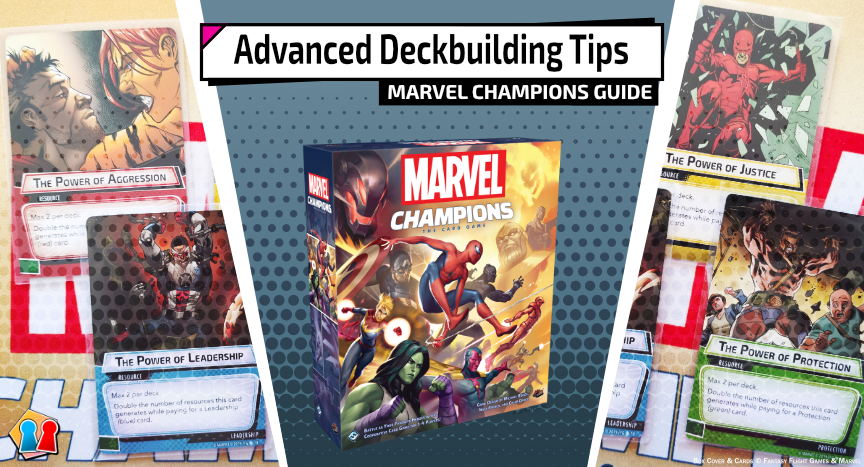
This article is intended as a companion piece to Marvel Champions: The Rules of Deck-Building. That one covers the what — deck size limits, aspect rules, and the mechanical basics. This one is about the why – the habits that tend to make decks feel smoother, more flexible, and make sure you don’t draw hands that do nothing except lose you the game.
None of this is set in stone. Like any theory, it’s always worth asking whether you should be following these tips for a specific hero or scenario. This also won’t help you to build crazy combo-led decks with specific niche interactions. These are just principles I keep coming back to that result in solid foundational decks, especially in multiplayer.
1. Thin the Deck
Play 40 cards, not 50.
Marvel Champions rewards this more than it first appears. Every hero comes with 15 fixed cards, and even the weaker hero sets usually have around ten cards you actively want to see. They’re efficient, they synergise, and they’re the reason deckbuilding in this game is as forgiving as it is. When a third of your deck already knows what it’s doing, it’s genuinely hard to go too far wrong.
Because of that, anything you add that isn’t a hero card has to earn its place. Every aspect card you include slightly reduces how often you see your hero’s best tools. Drawing an aspect event instead of a key hero upgrade is making your deck worse, even if it doesn’t feel that way at the time. Aspect cards should be covering gaps your hero kit doesn’t — extra thwart, better card draw, or ways to amplify what your hero already does well.
This is why upgrades and supports punch so far above their weight. Once they’re in play, they stop interfering with your draws and quietly make every future turn better. Anything you can get out of your deck and onto the table improves the quality of what you draw afterwards, and increases how often you can play your strongest hero events.
The main exception is Leadership decks that lean hard into allies. Even then, those decks still thin themselves naturally, and Leadership usually has access to excellent card draw.
2. Don’t Build Selfishly
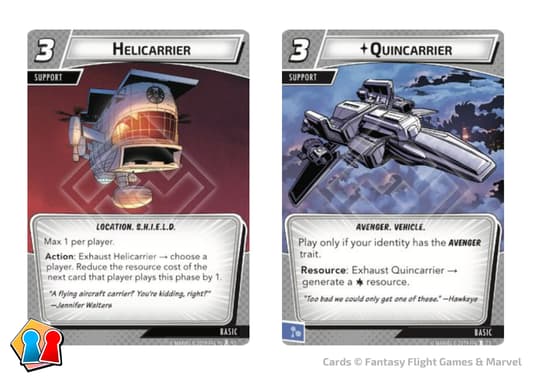
If you’re playing true solo (one hero vs the villain), some choices are obvious. You don’t need a second Heroic Intuition, and you can safely plan around unique supports like Quincarrier or the X-Jet being yours. In multiplayer (or two-handed), that logic falls apart very quickly. If four X-Men players all expect to use the X-Jet, three of them are going to be disappointed.
Being able to hand value to another player is enormous. Giving Heroic Intuition to the right hero can be game-defining. The same thinking is why I’ll take Helicarrier over Quincarrier almost every time. Being able to point that discount wherever it’s needed most is incredibly powerful, especially for low hand-size heroes who struggle to get their economy online.
A lot of decks you’ll see online are built as if the hero exists in isolation, because they’re designed for solo. In multiplayer, you’re much better off treating the table as a shared problem. That mindset often lets you thin your deck by prioritising upgrades that help the group, while also making you more tactically flexible.
Got a threat problem? Funnel resources into the Justice player and watch it go away.
3. Watch Your Costs
Hand size quietly dictates what your turns look like, which means card costs matter a lot more than they might seem.
Take a hero with a hand size of five. Ignoring resource generators for a moment, that hand can realistically play one expensive card per turn. A 4-cost card consumes your entire hand. A 3-cost card leaves you with one card afterwards, which rarely turns into anything meaningful. In practice, a 3-cost card often behaves like a 4-cost card.
Even once you factor in resource generators, the shape of the turn doesn’t change much. A 4-cost card is still basically your whole turn. A 3-cost card might leave you enough to play a 1-cost card, but those aren’t especially common. Playing two 3-cost cards in one turn usually requires things to line up perfectly.
Now compare that to lower-cost cards. Five cards and a resource lets you play two 2-cost cards with no extra setup. That’s two problems solved instead of one, and over a game that difference adds up fast.
This is why decks tend to perform better when they’re weighted toward cheaper cards. Expensive cards need to justify themselves. Either they reimburse you in some way, like Nick Fury or Avenger Mansion, or they need to be exactly what you want to be doing when you see them. If a 4-cost card isn’t exciting in your hand, it probably doesn’t belong in the deck.
4. 2-Cost Allies Are Ridiculously Good
A typical 2-cost ally does three things.
It enters play and does something useful. It activates once. Then it blocks an attack and leaves play.
Compare that to Invulnerability: toughness for three resources. You get a similar end result — you don’t take damage — but the ally gave you tempo, board impact, and flexibility along the way.
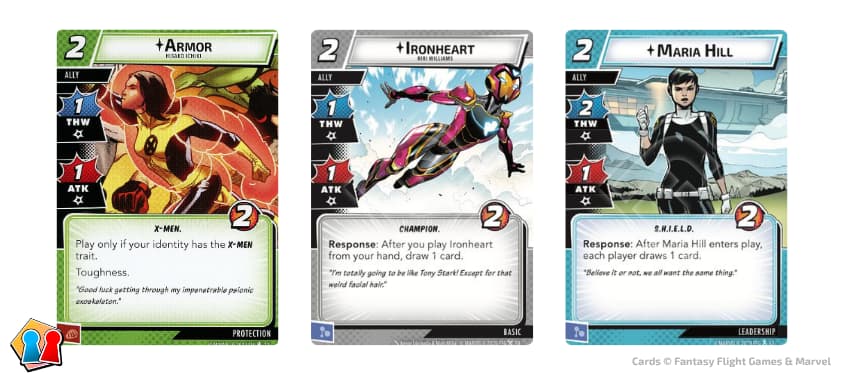
There’s a reason recent villains have started gaining Overkill more often. Cheap allies are extremely strong, and they always have been. Even with Overkill in the mix, it’s rarely consistent enough to outweigh how good these allies are at keeping games stable, with a few obvious exceptions.
5. Tune the Deck to the Challenge
There’s no shame in swapping cards between games.
This isn’t a competitive TCG where you’re expected to bring one deck that answers everything. A big part of deckbuilding skill in Marvel Champions is recognising how you lost and adjusting accordingly.
Lost badly to threat? Switch in more thwart. Villain handing out Overkill every turn? Those 2-cost allies might be less appealing now. That’s exactly what silver-bullet cards are for. Most villains have a preferred way to win — killing you outright, scheming aggressively, or doing something strange — and you can usually identify which one it is.
Treat the scenario as part of the puzzle. Build strong baseline decks, but know which cards you’re willing to swap when something isn’t working. If you’re familiar with Magic, it’s perfectly reasonable to think of this as a game with a sideboard.
6. Keep It Simple (But Don’t Be Seduced by Big Numbers)
If your deck revolves around a specific interaction, that’s fine — but then it needs to really revolve around it. You want to see those cards together reliably, not occasionally. You can’t do big combo nonsense without dedicating a chunk of your deck to finding and enabling it.
What tends to underperform are decks full of conditional ideas. Cards included because “if I draw this, and that, and that, I can do something clever”. Unless you can guarantee those draws, you’re usually better off sticking to generic, repeatable value.
None of this is meant to discourage experimentation — that’s half the fun of Marvel Champions. But if you build with these ideas in mind, you’ll usually end up with decks that feel smoother, more consistent, and more useful to the table as a whole.
It’s honestly hard for elaborate combo decks to outperform something very simple and very consistent, like using The Power of Justice to pay for For Justice!.
This ties into another common trap: judging cards purely by raw numbers. Thwarting for 4 looks better than thwarting for 2, so the bigger number feels more powerful. But excess output doesn’t carry over. If your hero can remove 2 threat, and there’s 2 threat left on a scheme, that’s a perfect answer to the problem in front of you. Thwarting for 4 in that situation isn’t stronger — the extra 2 just vanishes.
That makes raw numbers far more situational than they first appear. A card that thwarts for 4 isn’t automatically better than one that thwarts for 2 if most of the time you only need to clear 2 or 3 threat. Anything beyond that is wasted, and wasted output doesn’t help you win.
You can often see this coming from player count alone. A side scheme with 2× players threat enters play with 4 threat in two-player, 6 in three-player, and so on. That means the “right” thwart number changes with the table. Clear the Area has a smaller number, but at lower player counts it often removes exactly what’s needed, with a potentially huge upside. Bigger numbers can look impressive, but unless they line up with the problem on the board, they’re not doing extra work.